
9 min read
Sable Fur Guide: Russian Sable, Golden Sable, and What "Canadian Sable" Really Is
Vintage sable fur guide: Russian and Barguzin sable, golden sable, Sobol labels, and why "Canadian sable" is marten, not true sable.
Sable is the fur of the sable (Martes zibellina), a small marten found from the Ural Mountains across Siberia to northern Mongolia, and it has been one of the most valued furs in the trade since the early Middle Ages. Its hair is soft, silky and very light to wear, which makes it suited to someone who wants a fine, understated fur rather than the volume of fox. One warning before you shop: "Canadian sable" and "American sable" are trade names for American marten, a different species, so the name on a product is not always the animal in the coat.
This guide is written by TOKONAME FUR HOUSE, a vintage fur store in Tokoname, Aichi, Japan. It covers Russian sable (including Barguzin), golden sable, what "Canadian sable" really is, how sable compares with mink, and what to check before buying a vintage piece. For every fur type side by side, start with our types of fur guide.
Sable fur basics
Sable comes from one species, Martes zibellina, a member of the marten family native to Russia. Its fur ranges from light to dark brown, often with a light patch at the throat, and it is softer and silkier than the fur of American marten. Sable keeps its smoothness in every direction you stroke it, which is one of the qualities the fur is known for.
Structure: like other furs, sable has longer guard hairs over a soft underfur. In fine sable the guard hairs can carry silvery tips, and the amount of silver-grey tipping is one of the things the trade uses to grade value. The winter coat is longer and fuller than the summer coat.
Weight: sable garments are very light for a fur. In our experience sable is warm and of medium durability — between fox and mink; see the comparison table in our types of fur guide.
Price position: in our own shop data, sable sits at the top end of the price range, clearly above mink and fox. Sable also appears far less often than mink or fox in our stock, so most of the time there are only a few sable pieces to choose from. See current sable pieces →
Where sable comes from: Russia, Siberia and Barguzin
Almost all sable in the fur trade is Russian. Historically the most prized skins came from Irkutsk and Kamchatka, and the Barguzin area by Lake Baikal became the best-known name of all. Its sable population was so heavily hunted that the Barguzin Nature Reserve was created in 1916, the first nature reserve in the Russian Empire, specifically to protect the Barguzin sable.
Sable trapping restrictions and the development of sable farms later allowed the species to recolonise much of its former range, so modern sable can be wild or ranch-raised.
How to read Russian labels: Sobol and Soyuzpushnina
Two Russian words appear on sable labels. "Sobol" (соболь) is simply the Russian word for sable, both the animal and its fur. "Soyuzpushnina" (also spelled Sojuzpushnina) is the Russian fur trade organisation founded in 1931; it has run the international fur auctions in St. Petersburg (formerly Leningrad) ever since, and that auction has historically specialised in sable, with its prices setting the world price.
A Sobol or Soyuzpushnina label tells you the garment was presented as Russian sable. It is a useful clue, not a guarantee on its own: a label alone is not proof of what is inside, so read the label together with the hair itself (see the checks below). One of the Russian sable jackets in our stock carries a Sobol label.
Russian sable (including Barguzin)
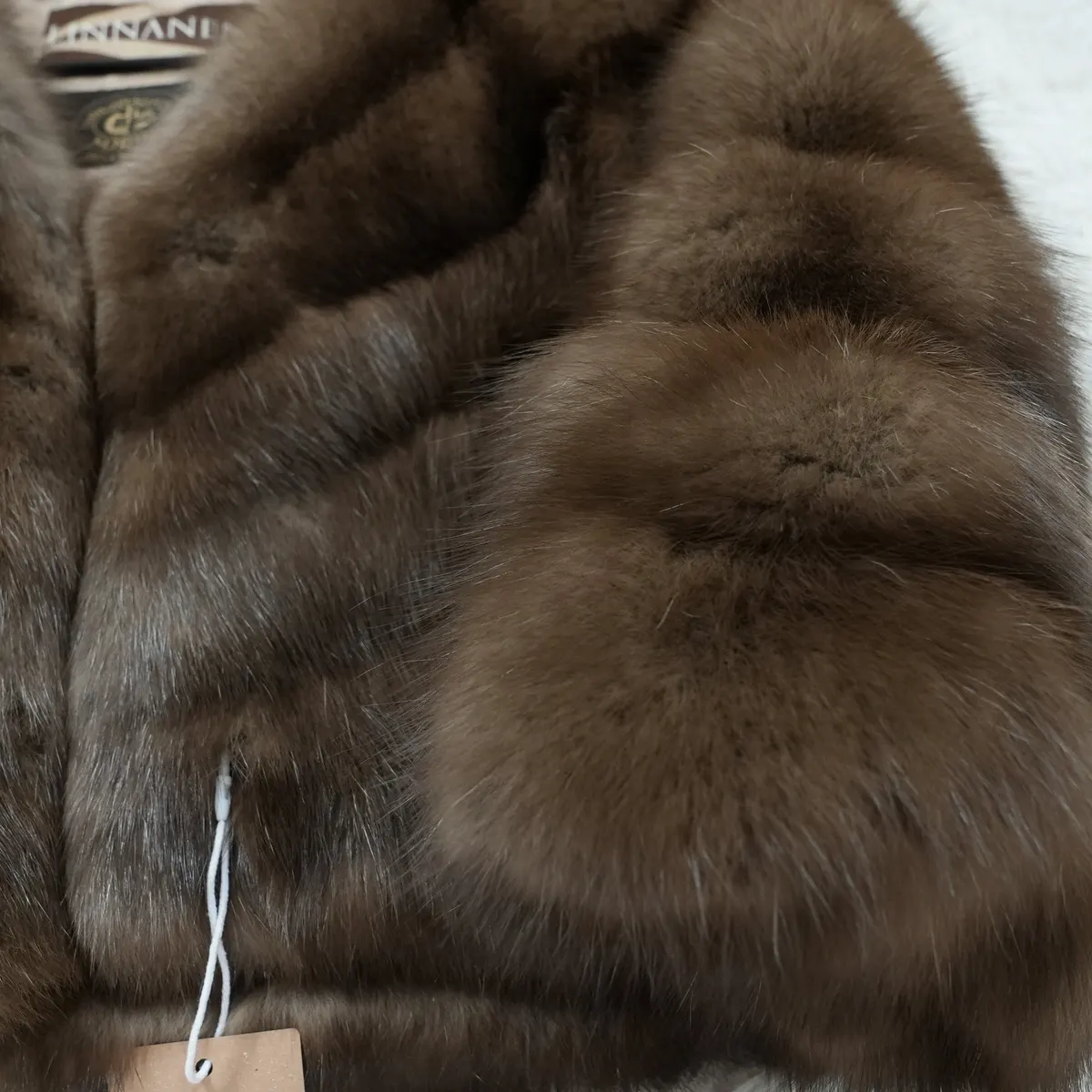
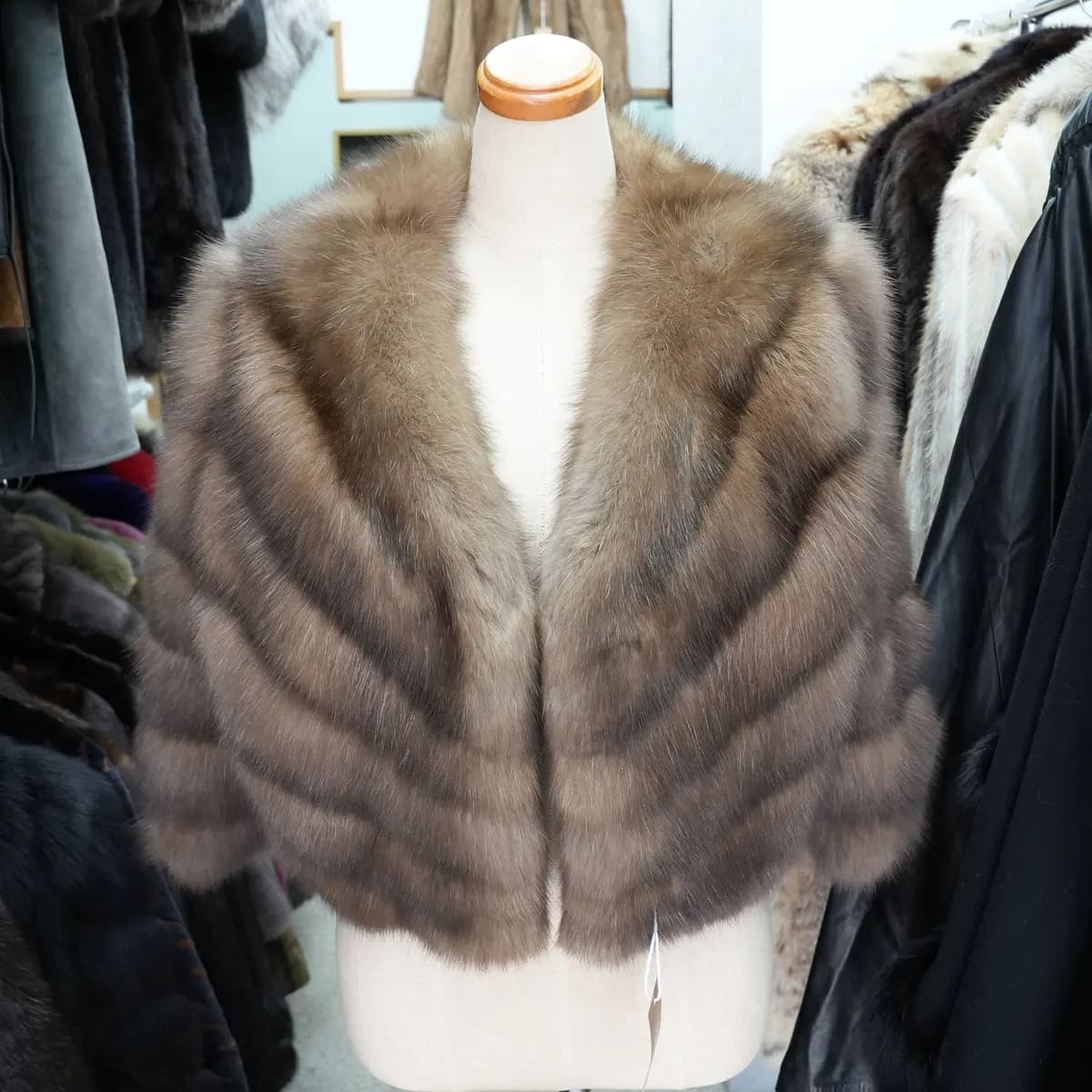
Russian sable is true sable, Martes zibellina, from Russia and Siberia. It is the sable most buyers mean when they say "sable", and it is the variety we have actually carried. Expect a brown fur with a silky, fine hand and often silvery tips in the guard hair.
Look: colour runs from light to dark brown. Barguzin sable is described as a deep, very dark fur with white-tipped hairs. The jacket in the photos shows the typical pattern of pelts worked in horizontal bands, with silvery guard hairs over a brown base.
As a coat: because sable is so light, a jacket or short coat does not weigh on the shoulders the way a dense, heavy fur can. In our stock, Russian sable has appeared mostly as cropped jackets, a zip-front hooded jacket, a cape and as trim on other garments, rather than as full-length coats.
- Pros: soft and silky hair that stays smooth whichever way you stroke it; very light for a fur; a natural brown that is easy to wear.
- Cons: at the top end of the price range; few pieces on the market at any time; the name is easy to confuse with "Canadian sable" (marten), so the label and description need checking.
- Also called: Russian sable, crown sable or imperial sable (historic names for the finest Russian sable), Barguzin sable (from the Barguzin area), Sobol (Russian label), セーブル / ロシアンセーブル (Japanese product names).
What is Barguzin sable?
Barguzin sable is sable from the Barguzin area by Lake Baikal in Siberia. It is generally regarded as the most valued of all sables, and the finest skins were historically reserved for the Russian imperial family, which is where the names crown sable and imperial sable come from. The fur of this population is described as very dark with white-tipped hairs.
On a vintage piece, "Barguzin" is a description of origin and quality. We do not judge a coat as Barguzin from the colour alone; we go by the label and the information that comes with the coat.
Golden sable
Golden sable is not a separate species; it is a colour description for lighter, warmer-toned sable. The trade describes it as light cinnamon brown, sandy yellow or straw yellow. Golden sable is generally less expensive than prime dark sable.
Look: a lighter, honey-to-straw tone, without the deep brown of dark Russian sable. As a coat: the lighter colour reads softer and more casual than dark sable, and it is the same light, silky fur. See current sable pieces →
- Pros: the same light, silky sable hair; a warmer, lighter colour; usually below dark sable in price.
- Cons: lighter colours show wear and discolouration more readily, so check shoulders and cuffs closely.
- Also called: golden sable, ゴールデンセーブル (Japanese product name).
What "Canadian sable" really is
"Canadian sable" and "American sable" are fur trade names for the American marten (Martes americana), not for true sable (Martes zibellina). The two animals are close relatives in the same genus, and marten fur was called sable-like and traded heavily for that reason, but they are different species from different continents. In general, Canadian sable sits clearly below Russian sable in price, and its fur is less dense.
American marten lives across Canada and the northern United States, including Alaska. Its fur is long and silky and ranges from pale yellowish buff through tawny brown to almost black, usually with a throat patch ("bib") in a different colour. True sable is softer and silkier, and Russian sable is denser and silkier than Canadian sable.
Marten is a good fur in its own right; the issue is only the name. If you are paying a sable price, make sure you are buying sable. For marten in general, see the marten section of our types of fur guide.
| Russian sable | "Canadian / American sable" | |
|---|---|---|
| Species | Sable, Martes zibellina | American marten, Martes americana |
| Where it lives | Russia, from the Urals across Siberia; northern Mongolia | Canada and the northern United States, including Alaska |
| Hair | Softer and silkier; denser | Long and silky, but less dense than Russian sable |
| Colour | Light to dark brown, often silvery-tipped; Barguzin very dark | Pale yellowish buff to tawny brown to almost black, with a contrasting bib |
| Price position | Top end | Clearly lower than Russian sable |
| Label clue | Sobol / Soyuzpushnina (Russian) | Product names "Canadian sable", "American sable" or "marten" |
How not to be misled by the product name
These checks are clues you can see or ask about. None of them replaces a furrier's examination, but together they make a mix-up much less likely.
- Read the whole product name: "Canadian sable", "American sable" or "sable-like" means marten, not Russian sable.
- Look at the label: Sobol (соболь) or Soyuzpushnina points to Russian sable; a label naming marten, or no label at all, means you should ask.
- Ask the seller directly: "Is this Martes zibellina (Russian sable) or marten?" and "Where is it from?" A seller who knows the piece can answer.
- Check the hair: true sable is very silky and stays smooth when stroked in any direction; compare density with photos of known Russian sable.
- Check whether the price matches the claim: a Russian sable description at a clearly marten-level price is a reason to ask more questions.
- Check how much of the garment is sable: some pieces use sable only as a collar or trim on a mink or knit garment.
Mink vs sable
Choose sable for the lightest, silkiest hand and a soft natural brown; choose mink for a wider choice of natural colours, proven durability and far more pieces to pick from. Sable sits above mink in price in our stock. For the mink side, see our mink fur guide; for fox, the fox fur guide.
| Sable | Mink | |
|---|---|---|
| Hair | Silky, with silvery-tipped guard hairs; silkier than mink | Short, very thick and soft |
| Colours | Light to dark brown; golden (lighter) tones | Wide natural range, from white to near-black |
| Weight | Very light | — |
| Durability | Medium (our experience) | High among furs (store rule of thumb: rabbit < fox < mink) |
| Price position (our stock) | Top end | Wide range, below sable |
| How often you will find it | Occasionally, a few pieces | One of our two main categories |
How to choose a vintage sable
Start by confirming that it is sable at all (see the checks above), then judge condition the same way you would any vintage fur. Sable is light and fine, so wear shows quickly at the friction points. The full step-by-step checks are in How to Authenticate Vintage Fur.
If you can touch the piece: the leather side must not be dry and must have no tears. Tears tend to appear under the arms and around the collar first. Move the garment gently; if it crackles or makes a dry, rustling sound, avoid it — that is a sign the leather has dried out and is breaking down. Check the softness of the tanning: in general, the softer, the better.
If you can only see photos: look at the shoulders and cuffs, where condition shows first — thinning hair or discolouration. Sellers who show the weak points in photos and comments are easier to trust than those who hide them. It helps to compare several items and conditions on the same site, and check that the seller describes condition honestly, before you buy.
Some inexpensive new fur coats are made by stretching the pelts thin. They feel light and soft, but tend to lack the density and durability of a well-made older coat. A vintage coat gives an existing garment a second life — worth weighing against buying new.
Size: sable is often cut as jackets and capes, which are more forgiving than long coats, but measure shoulder, bust and sleeve anyway — see our vintage fur sizing guide. See current sable pieces →
Frequently asked questions
Is sable the most expensive fur?
Sable has been one of the most highly valued furs since the early Middle Ages, and Barguzin sable is regarded as the most valued of all sables. In our own shop, sable sits at the top end of our price range, above mink and fox. We do not rank it against every fur on the market.
What is the difference between sable and mink?
Sable (Martes zibellina) is silkier and very light, with silvery-tipped guard hairs and a brown colour range. Mink has short, very thick, soft hair, a wider range of natural colours and good durability. Sable is usually priced above mink and is much rarer. See the mink fur guide.
Is Canadian sable real sable?
No. "Canadian sable" and "American sable" are trade names for American marten (Martes americana), a related but different species. True sable is Martes zibellina from Russia and Siberia. Russian sable is denser and silkier than Canadian sable, and it is priced well above it.
What is Barguzin sable?
Barguzin sable comes from the Barguzin area by Lake Baikal in Siberia. It is regarded as the most valued sable; the finest skins were historically reserved for the Russian imperial family, hence the names crown or imperial sable. The Barguzin Nature Reserve was founded in 1916 to protect it.
What does "Sobol" on a fur label mean?
Sobol (соболь) is the Russian word for sable. Labels may also name Soyuzpushnina, the Russian fur trade organisation that has run the St. Petersburg fur auctions since 1931. Both point to Russian sable; read them together with the hair and the seller's description.
Related category
Fur