
13 min read
Mink Fur Guide: Colors, Types and What to Look For in Vintage Mink
Vintage mink fur colors explained: Blackglama, mahogany, demi-buff, pastel, sapphire, pearl and white, with photos, Japanese names and buying checks.
Mink is a short, dense, glossy fur that comes in a wider range of natural colours than most furs, from near-black dark mink and mahogany through demi-buff and pastel browns to sapphire grey, pearl and white. It is also among the more durable furs, so a well-kept vintage mink coat can be worn through the winter rather than saved for special occasions. This guide from TOKONAME FUR HOUSE, a curated vintage fur store in Tokoname, Aichi, Japan, covers each mink colour we have carried, how to read mink labels, and what to check before you buy.
Because the colour range is so wide, mink is a fur where owning more than one piece makes sense: a dark coat for evenings, a pale pastel or pearl jacket for daytime, and you choose by mood rather than by occasion. If you are looking for advice on shapes, sources and prices when buying in Japan, see our separate buyer's guide to vintage mink coats in Japan; this page is the colour and type reference.
Mink fur basics
Mink fur has two layers: silky, glossy guard hairs on top and a thick, soft underfur beneath. The hairs are short, the guard hairs do not break readily and the underfur does not tend to mat, which is why mink is regarded as a durable fur. The long list of mink colour names comes from ranch-bred American mink, selectively bred for colour.
Structure: guard hair and underfur
Mink has a dense, lightweight fur with lustrous guard hairs over a lush, soft underfur. In the wild animal, the thick underfur and oily guard hairs make the coat water-resistant.
A simple touch test tells you a lot: better pelts have silky guard hairs and an even-textured underfur. Female pelts are generally smaller, softer, silkier, lighter and higher in lustre than male pelts, though that alone does not make a coat better.
Warmth, weight and durability
Mink is a dense yet lightweight fur: the thick underfur gives the warmth, and the short hair keeps the coat slimmer than a long-haired fur such as fox.
As a general rule of thumb from handling coats in our store, durability runs rabbit < fox < mink — mink is the most durable of those three. Published references agree: mink's guard hairs do not break readily and its underfur does not tend to mat, and in terms of resistance to wear and hide stability, mink is now considered one of the most rewarding fur materials, a place once held by otter.
One weakness is light: sunlight gradually fades the original dark brown of mink to a warmer tone. Storing a dark coat away from windows helps it keep its colour.
Origins: from wild trapping to North American ranches
Mink was not trapped in any quantity until the 19th century and did not become fashionable until the mid-20th century. Wild mink are small — males weigh around 1 kg — which made them hard to work into a full garment.
Breeding American mink for fur began in the late 19th century, when demand outgrew what wild trapping could supply. Ranch breeding produced larger animals, and the fur sewing machine made it possible to "let out" a pelt — processing it into narrow strips and sewing them back together so the skin becomes almost twice as long.
Ranches also produced colour. As early as 1930, breeders had developed clear light-blue sapphire, silverblue and white mink, and today farm-bred mink can vary from white to almost black. Mink is now described as the most popular fur traded worldwide.
Why there is so much vintage mink in Japan
From the 1960s through the 1980s, Japanese department stores and specialist furriers sold mink widely, often custom-fitted and properly lined, to customers who treated a coat as a long-term garment. That generation's coats are now coming back into the secondary market, which is why mink is the largest single category in our own stock, with fox close behind. For more on this background, see why Japan's vintage fur market looks the way it does.
Reading mink labels: Blackglama, American Legend, EMBA, Kopenhagen, SAGA
A pelt label tells you which breeders' association or auction house marketed the skins. It is useful for identifying the colour and origin, but it does not tell you how the coat was stored, so always judge condition separately. These are the mink labels we see most in vintage coats: Labels can also be added to a coat after the fact (see the Blackglama caution below), so judge the fur itself, not only the label.
- Blackglama — a trademark of the Great Lakes Mink Association (founded 1941) for its darkest mink, described by the association as "the richest, deepest, most lustrous dark mink with the lightest, most flexible leather." It is known for the "What Becomes a Legend Most?" advertising campaign, which ran from 1968.
- EMBA — the Mutation Mink Breeders Association, formed in 1942, adopted the name EMBA in 1948. As the name says, its members bred mutation (non-standard) colours, and its trademark was "The American Mink."
- American Legend — the cooperative formed in 1986 when the Great Lakes Mink Association and EMBA merged, marketing mink from ranches in the United States and Canada. It was acquired, with the Blackglama brand, by North American Fur Auctions in 2018.
- Kopenhagen Fur — a Danish breeders' cooperative and once the world's largest fur auction house, near Copenhagen. In 2020 it announced plans to wind down and liquidate its assets.
- SAGA — the label of Saga Furs, a fur auction house based in Vantaa, Finland. It is best known on fox, but Saga Furs also sells mink in colours such as Royal Black, pastel, mahogany, white and brown.
Mink colours, one by one
The colours below are natural colour types fixed by selective breeding on ranches, not dyes; the naturally brown farmed mink is traded as "standard" mink. Colour names are applied a little loosely in the trade, so treat them as families rather than exact shades. Below are the colours we have carried, each with a close-up and, where we have one, the coat on a mannequin, plus the Japanese name you will see on Japanese listings.
Blackglama and dark ranch mink
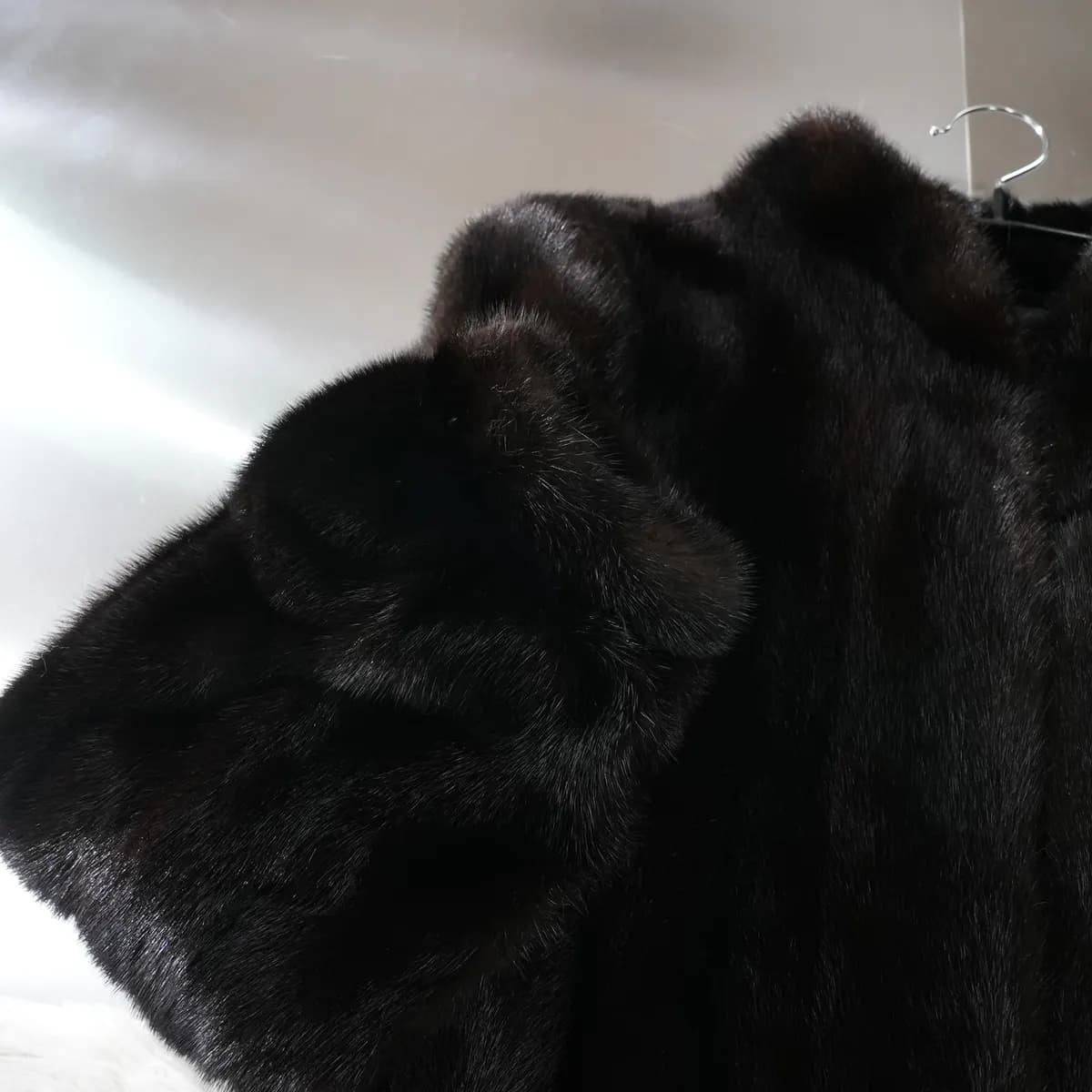
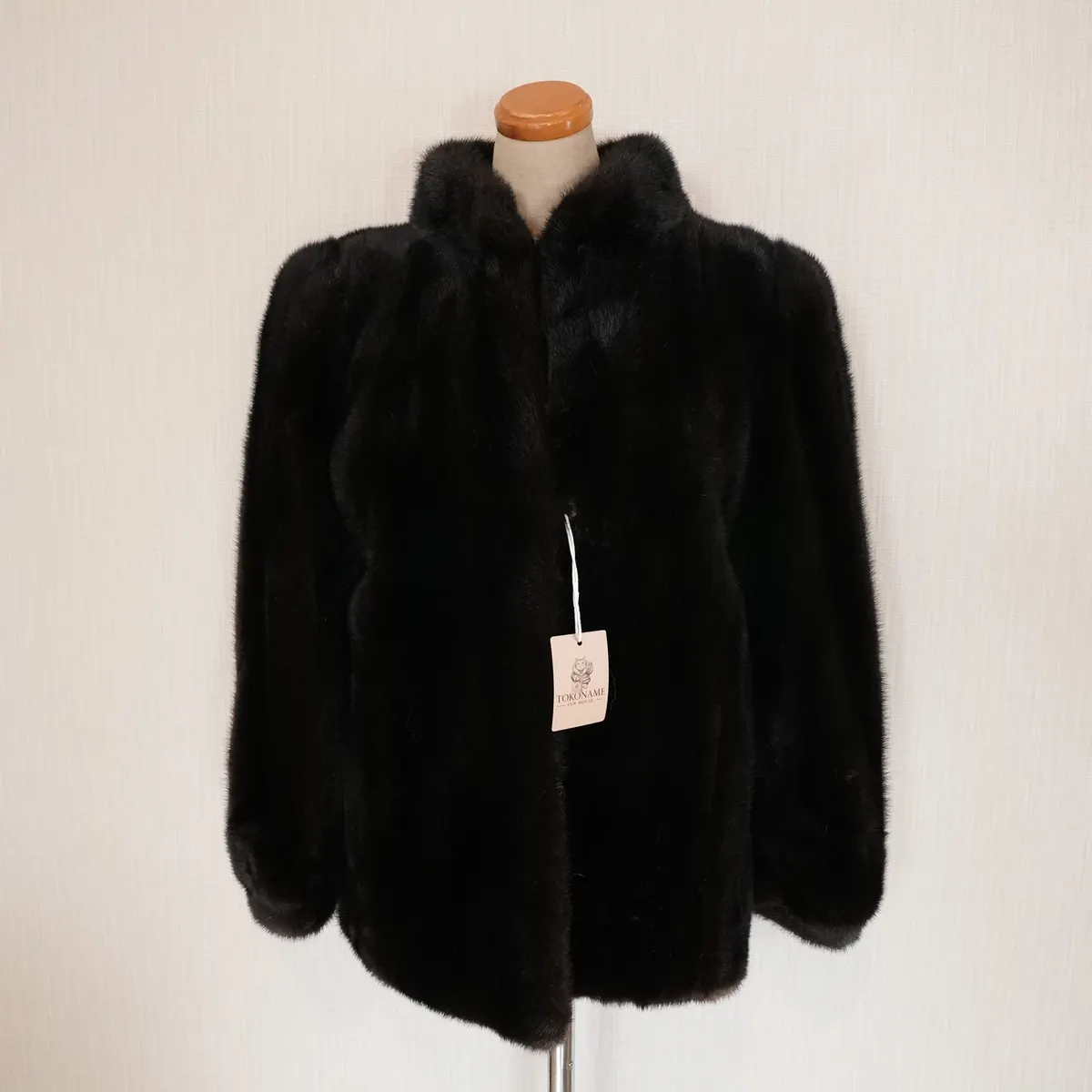
Dark ranch mink is the deepest natural brown, close to the colour of the wild animal; Blackglama is the label for the darkest, most lustrous of these skins. It is the classic "mink coat" colour.
Look: a very dark brown that reads almost black, with strong shine on the guard hairs. It is darker than mahogany, but it is not true black.
As a coat: the most formal of the mink colours, and the easiest to wear with black or navy. It works equally over evening wear and a plain winter outfit.
Pros: timeless and easy to match. Cons: dark brown fades toward a warmer tone in sunlight, so check for uneven colour on the shoulders and sleeves.
Caution: because Blackglama is a premium label, some ordinary dark mink coats circulate with a Blackglama label added afterwards. If you buy on the label alone, you may be misled. Look at the balance between the guard hairs and the underfur instead — it can be judged even from photos.
Also called: dark mink, ranch mink, dark ranch. Japanese: ブラックグラマ (Blackglama), ダークミンク.
Black mink
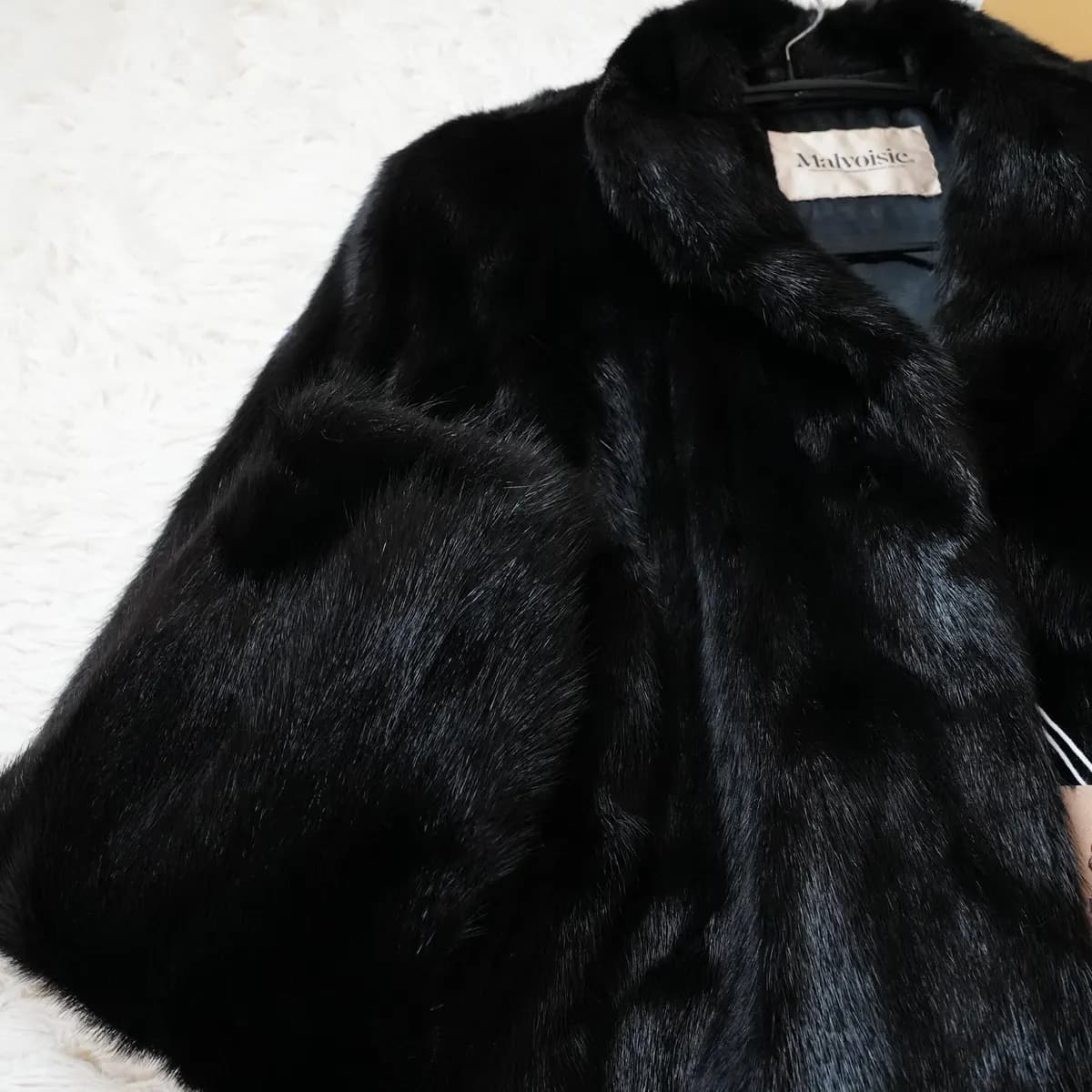
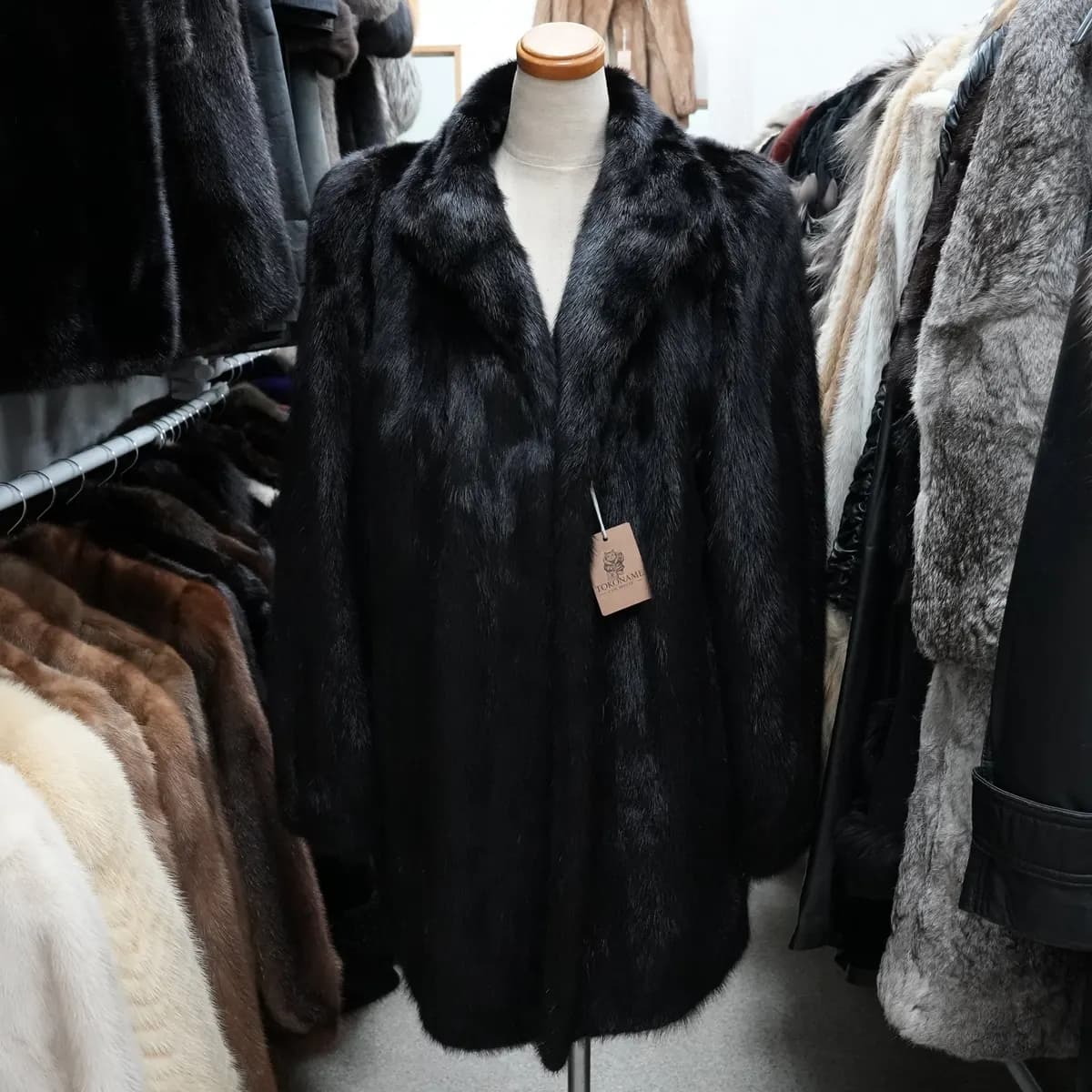
Black is its own colour type at fur auctions, separate from the dark browns; an auction study lists black and scanblack as separate types, and Saga Furs sells a "Royal Black." Dark ranch mink, by contrast, is very dark but not black.
Look: black guard hairs with a glossy finish; in daylight, it shows less brown than Blackglama or dark ranch.
As a coat: sharp and modern, easy to dress up or down. A black mink jacket over jeans looks less formal than a full-length dark brown coat.
Pros: the most versatile colour for everyday wardrobes. Cons: black mink and Blackglama are easy to confuse in listings, so check the label if the distinction matters to you.
Also called: Royal Black (Saga Furs), Scanblack (an auction colour type). Japanese: ブラックミンク.
Mahogany mink
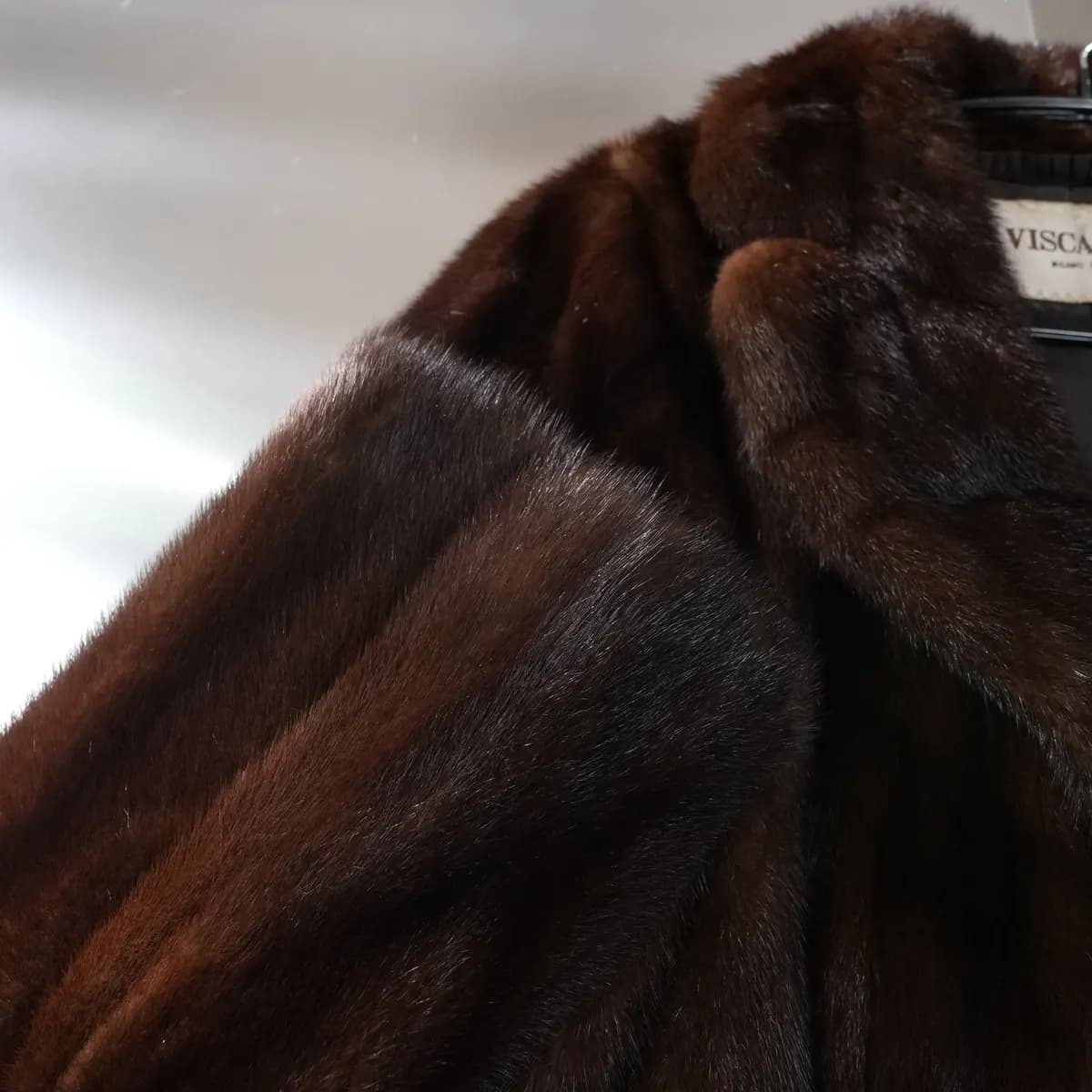
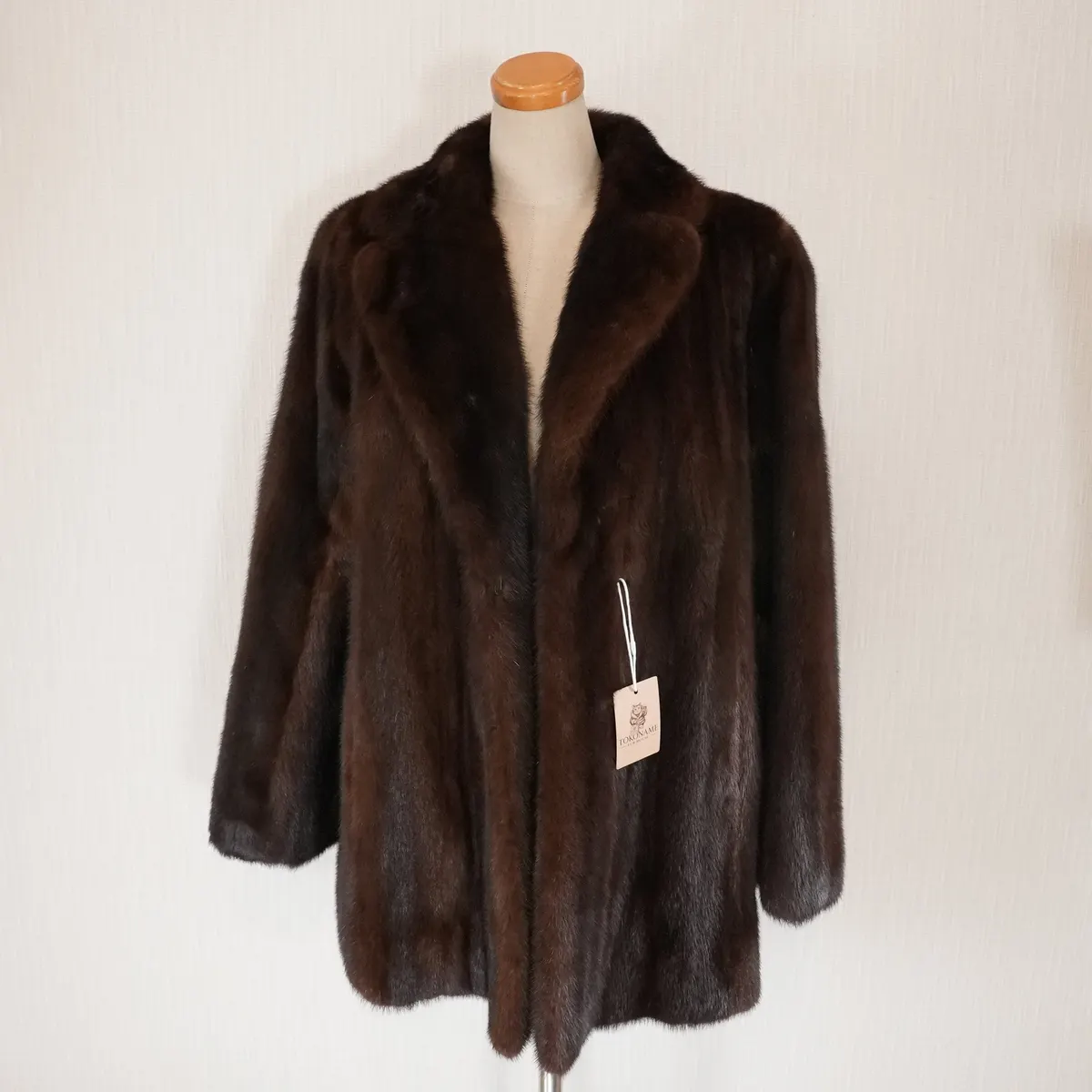
Mahogany is a rich brown mink, a step lighter than dark ranch. It is one of the main brown colour types sold at fur auctions.
Look: deep brown with a warm cast; in the coat pictured, the guard hairs catch the light with a reddish-brown glow.
As a coat: warmer and softer than black or dark mink, while still formal enough for evenings. It flatters camel, cream and grey clothing.
Pros: a classic brown that looks warm in daylight. Cons: we see it less often than demi-buff or sapphire, so there is less choice of sizes and shapes at any one time.
Also called: mahogany brown. Japanese: マホガニー.
Demi-buff mink
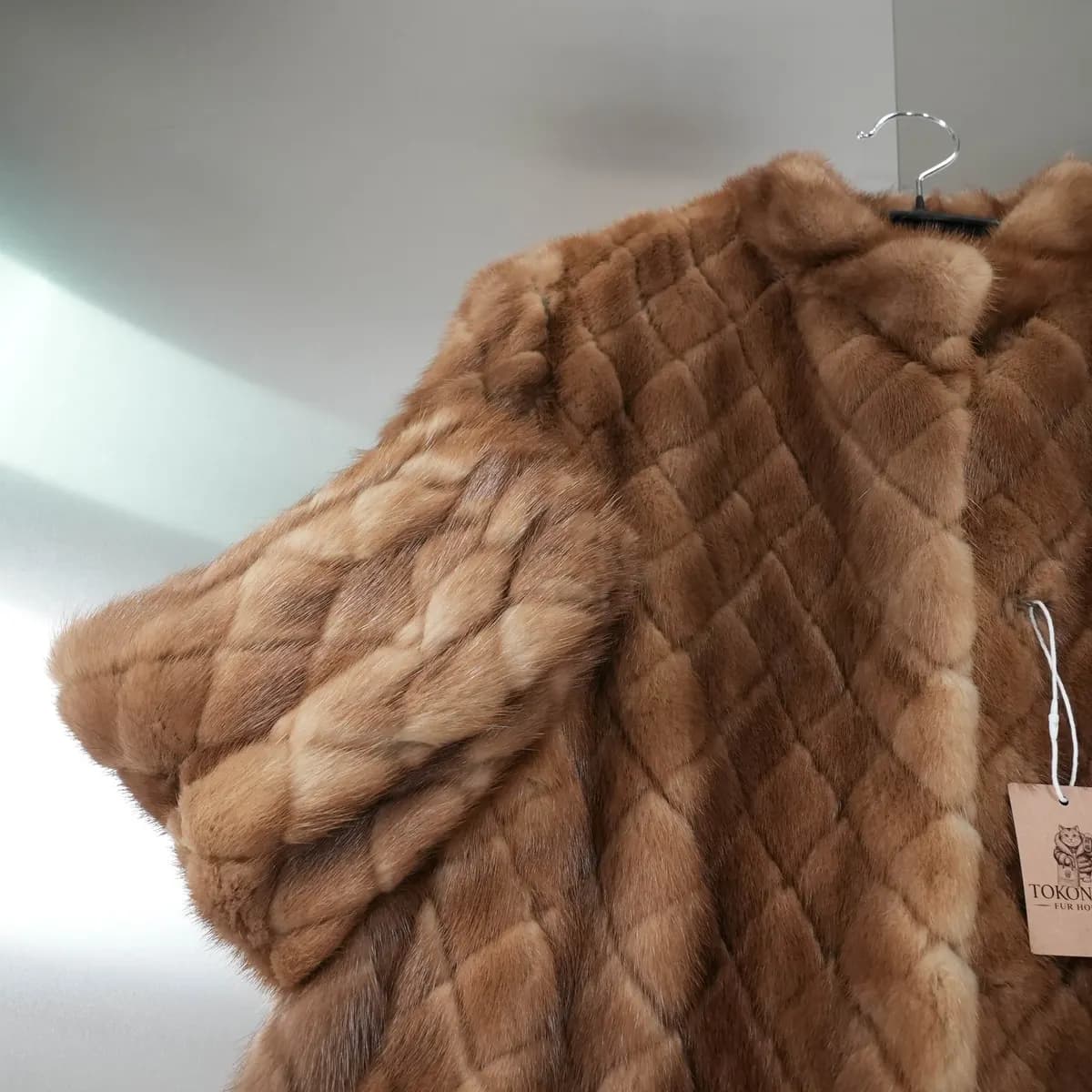
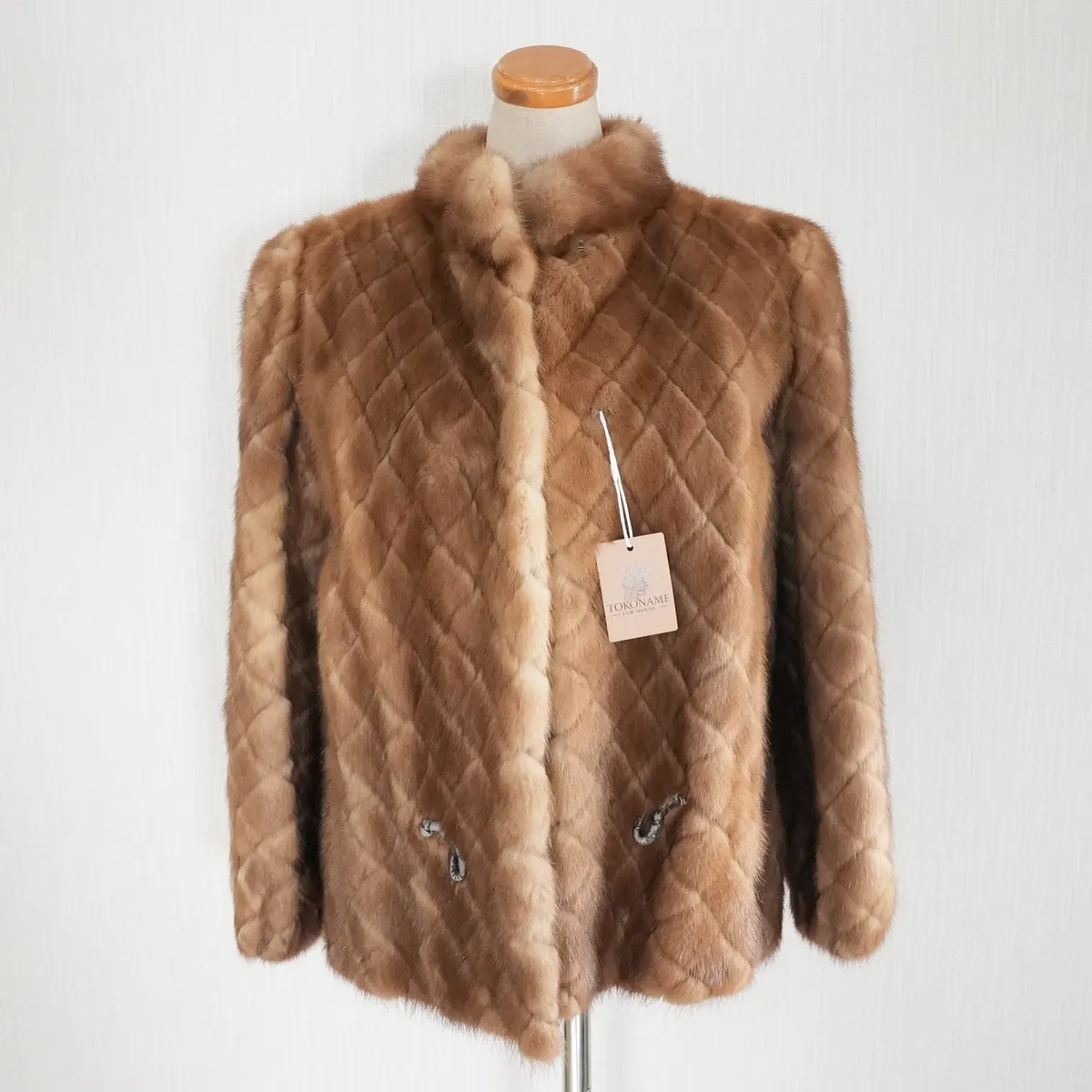
Demi-buff is a natural mid-brown mink, slightly darker and browner than pastel. In our stock it is one of the most common mink colours.
Look: a warm brown that sits between pastel and mahogany; shades vary from coat to coat, and the jacket pictured, worked in a diamond-cut pattern, reads as a golden brown.
As a coat: a relaxed, daytime brown that is easier to wear casually than dark mink. It suits denim, knitwear and earth tones.
Pros: softer than dark mink, still classic, and widely available. Cons: because shades vary, two "demi-buff" pieces may not match; compare photos taken in daylight.
Also called: demi buff, demi. Japanese: デミバフ.
Pastel mink
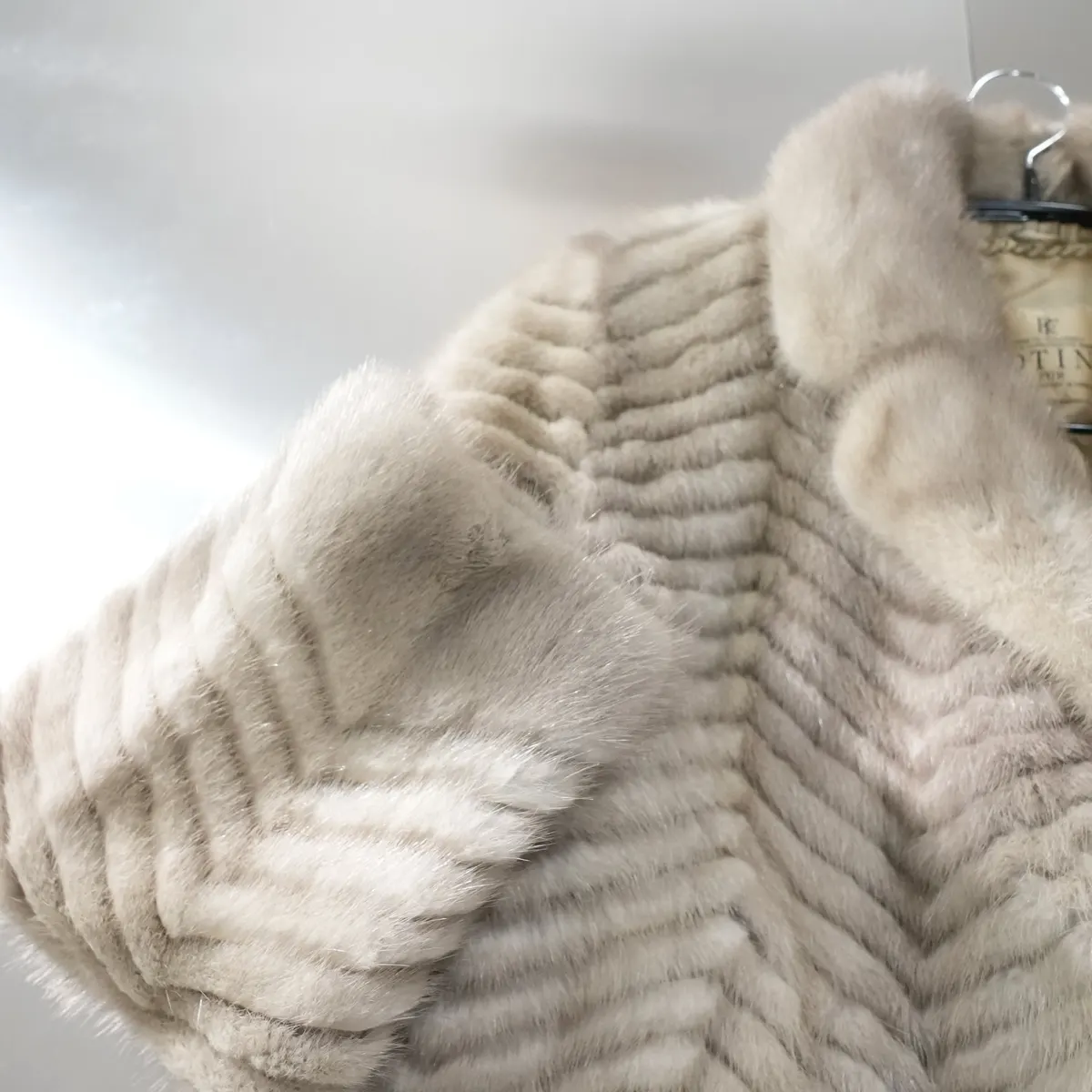
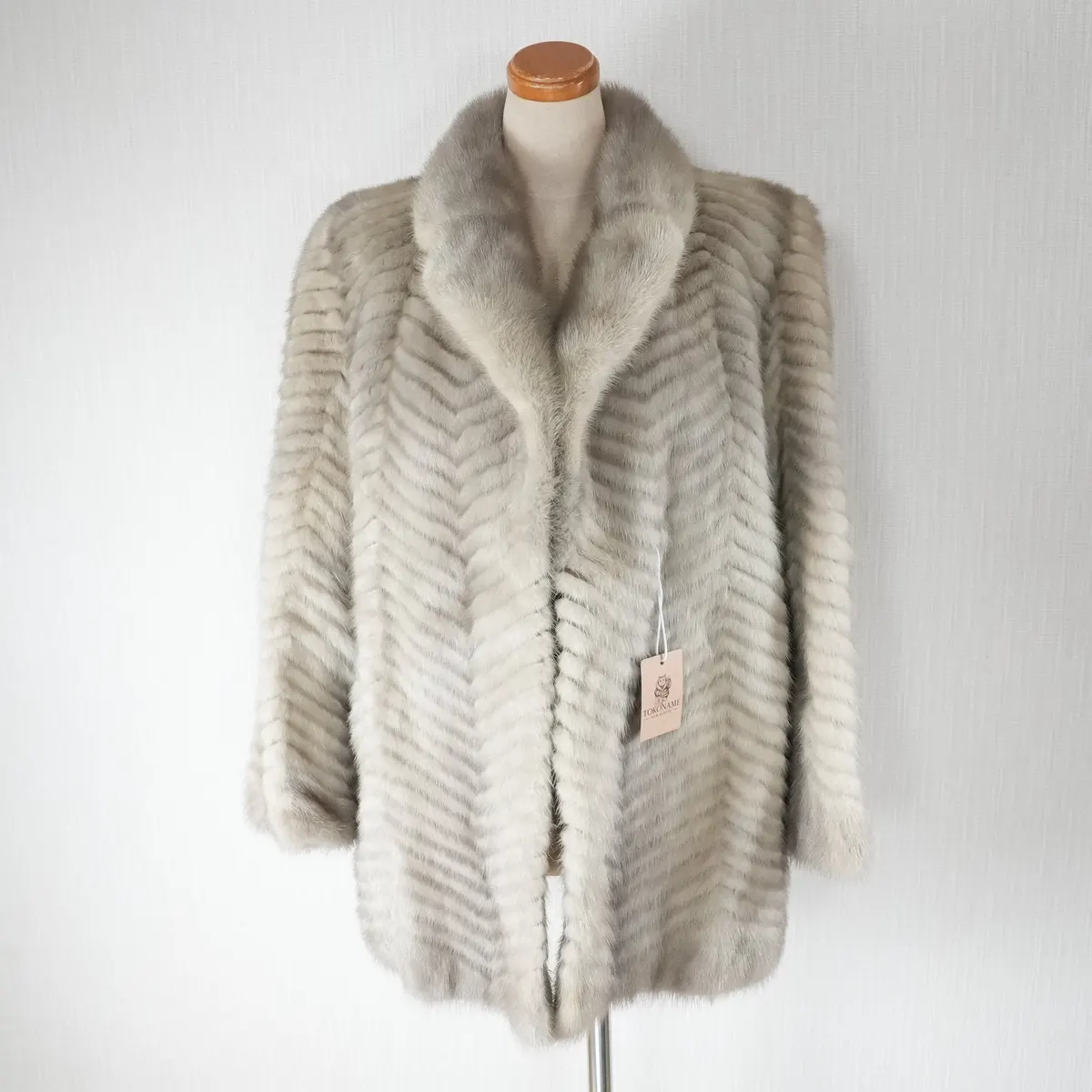
Pastel is one of the classic mutation colours: pale brown and beige underfur with darker guard hairs. Pastel mink ranges from light brown to dark brown.
Look: a soft, muted brown with visible contrast between the darker guard hairs and the paler underfur. The coat pictured is worked in a chevron pattern.
As a coat: light and easy, a good daytime colour that looks less formal than dark mink.
Pros: a gentle, flattering brown that pairs with most neutrals. Cons: on a pale fur, any discolouration at the cuffs, collar and shoulders is easy to see, so check those areas closely.
Also called: Royal Pastel (a variety with a bluish cast). Japanese: パステル.
Sapphire mink
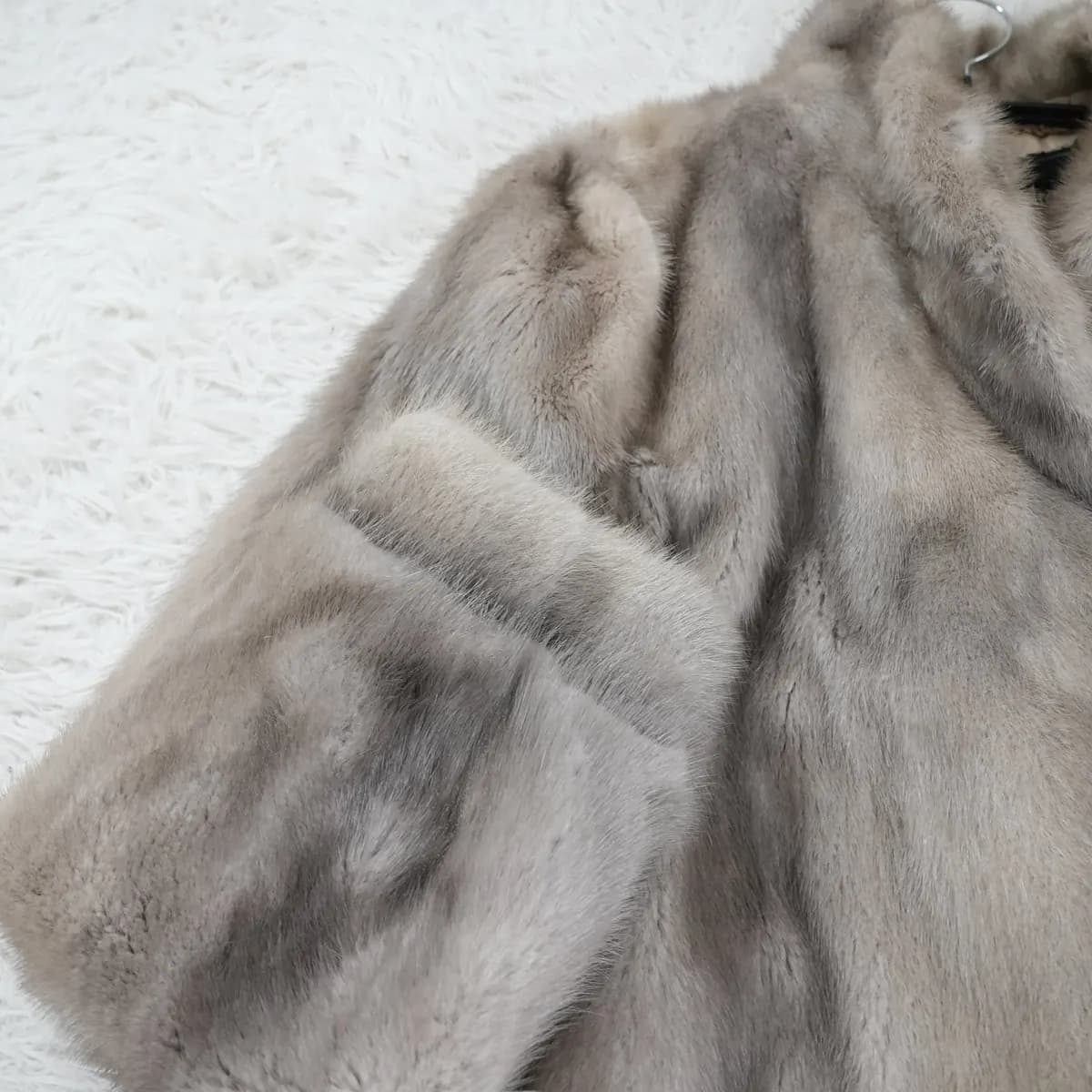
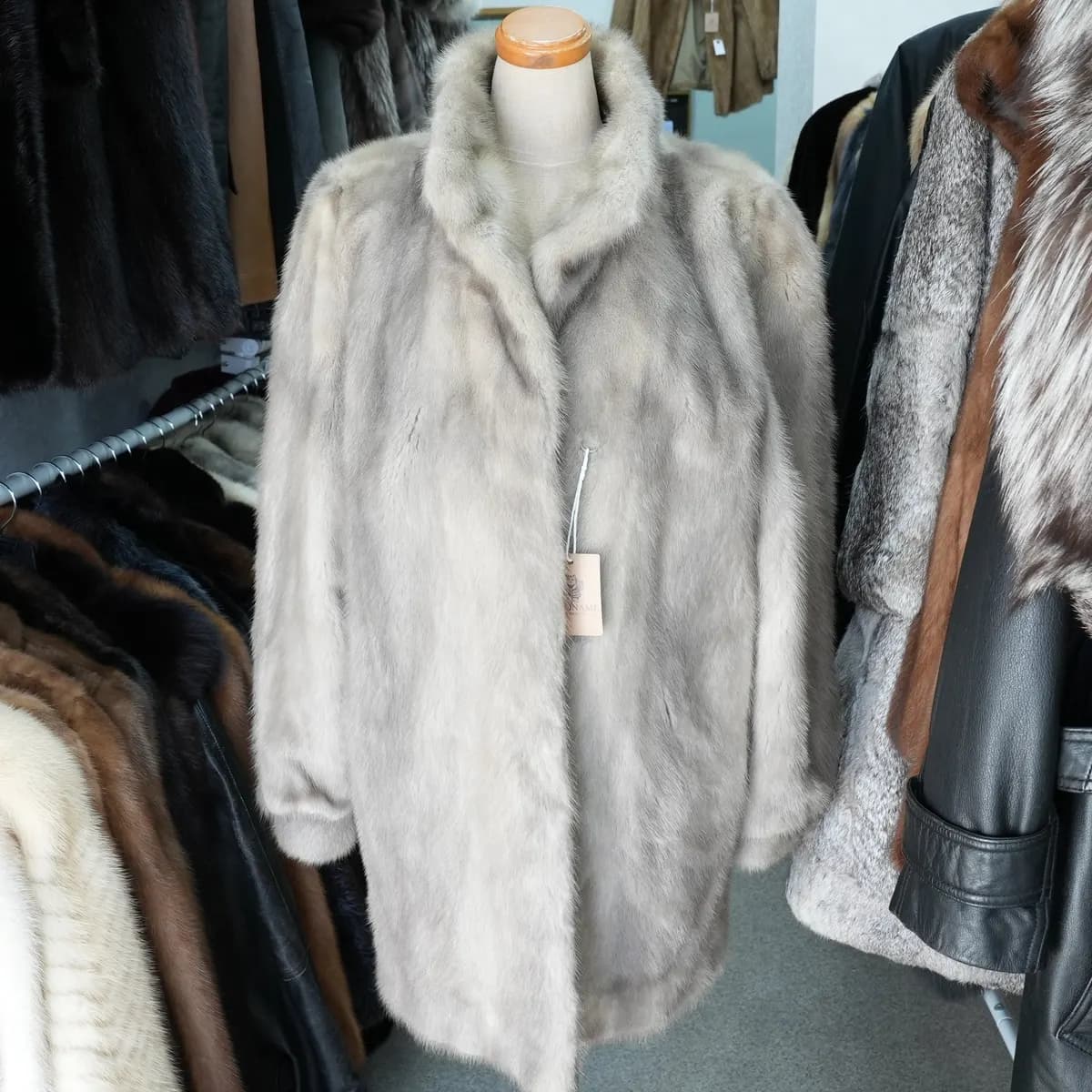
Sapphire is a natural blue-grey mink, one of the earliest ranch mutations, developed by around 1930. It is not dyed; the colour comes from breeding.
Look: bluish-grey underfur with mauve or blue-grey guard hairs. Sapphire ranges from light to darker grey but tends to be lighter and bluer than blue iris mink.
As a coat: cool and soft, sapphire works with grey, black, white and denim and looks less formal than dark mink. It is one of the mink colours we carry most often.
Pros: a distinctive natural colour that is still easy to wear. Cons: sapphire is easy to confuse with blue iris mink, which is darker and greyer, so compare photos carefully.
Also called: Cerulean. Japanese: サファイア.
Pearl mink
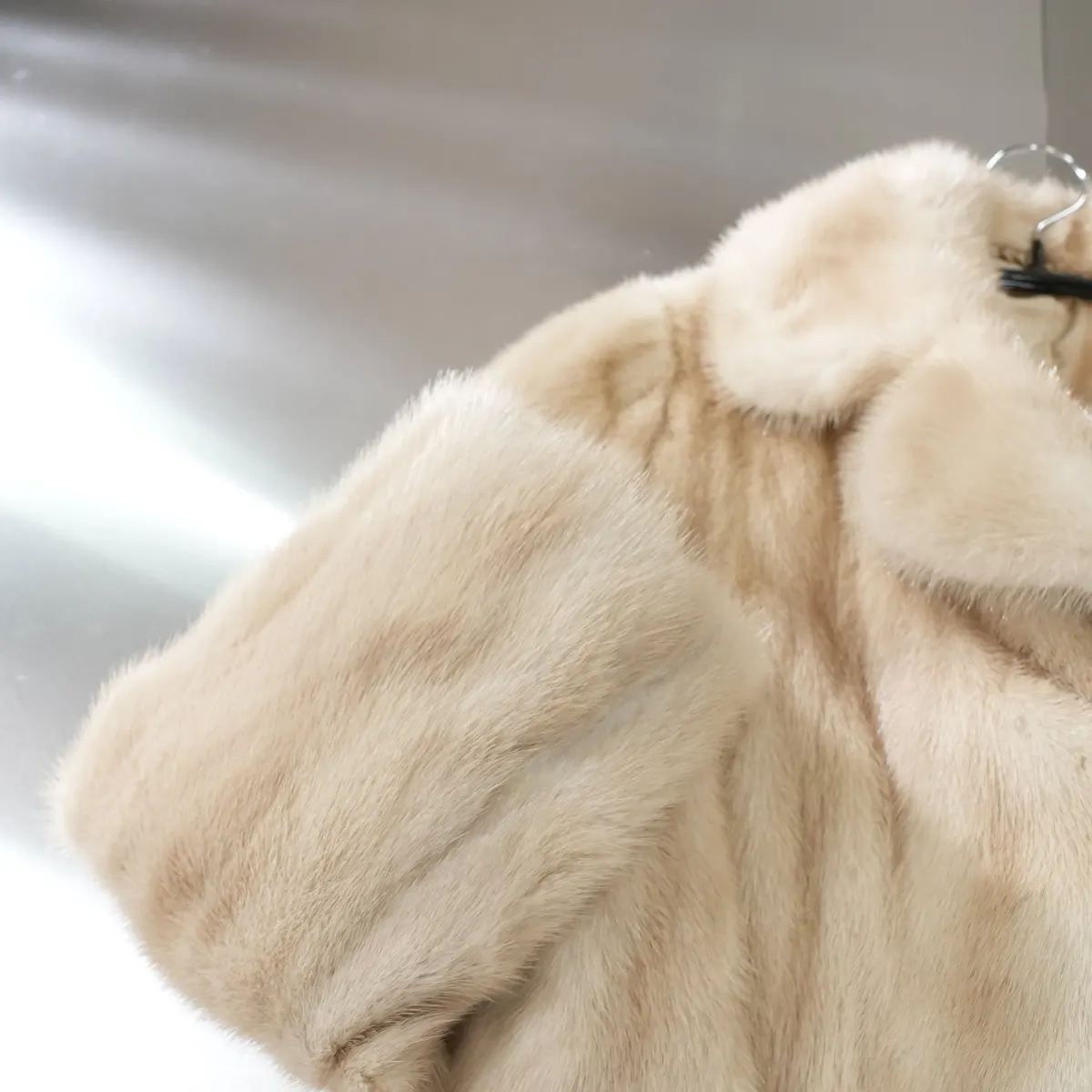
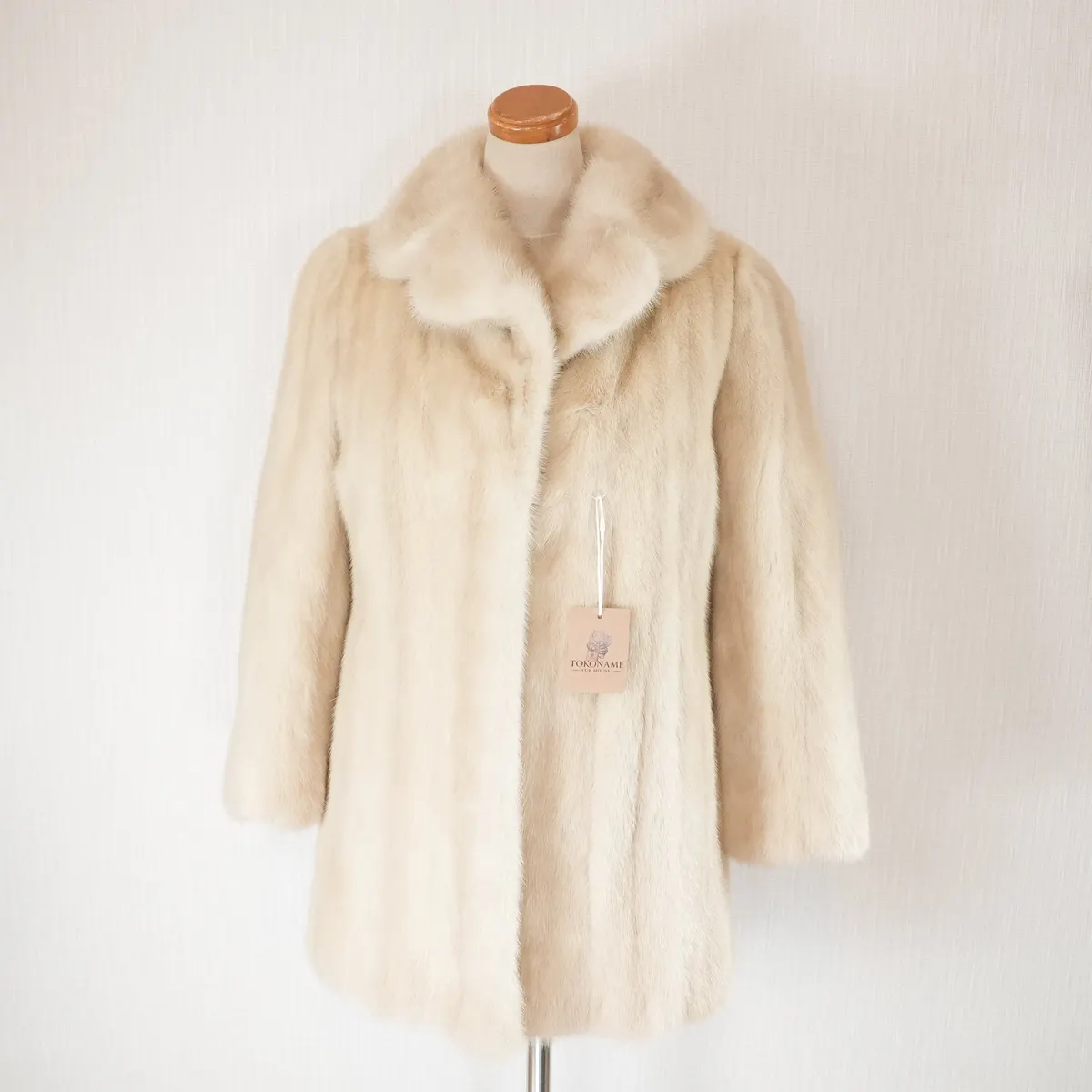
Pearl is a pale, off-white mink with a slight tan tone.
Look: a soft off-white with a hint of tan, warmer than white mink.
As a coat: bright and gentle, easy to wear in daytime and with light colours. It looks softer than white mink.
Pros: a pale mink that is less stark than white. Cons: on a pale fur, discolouration at the collar, cuffs and shoulders is easy to see, so check those areas closely.
Also called: Japanese: パール.
White mink
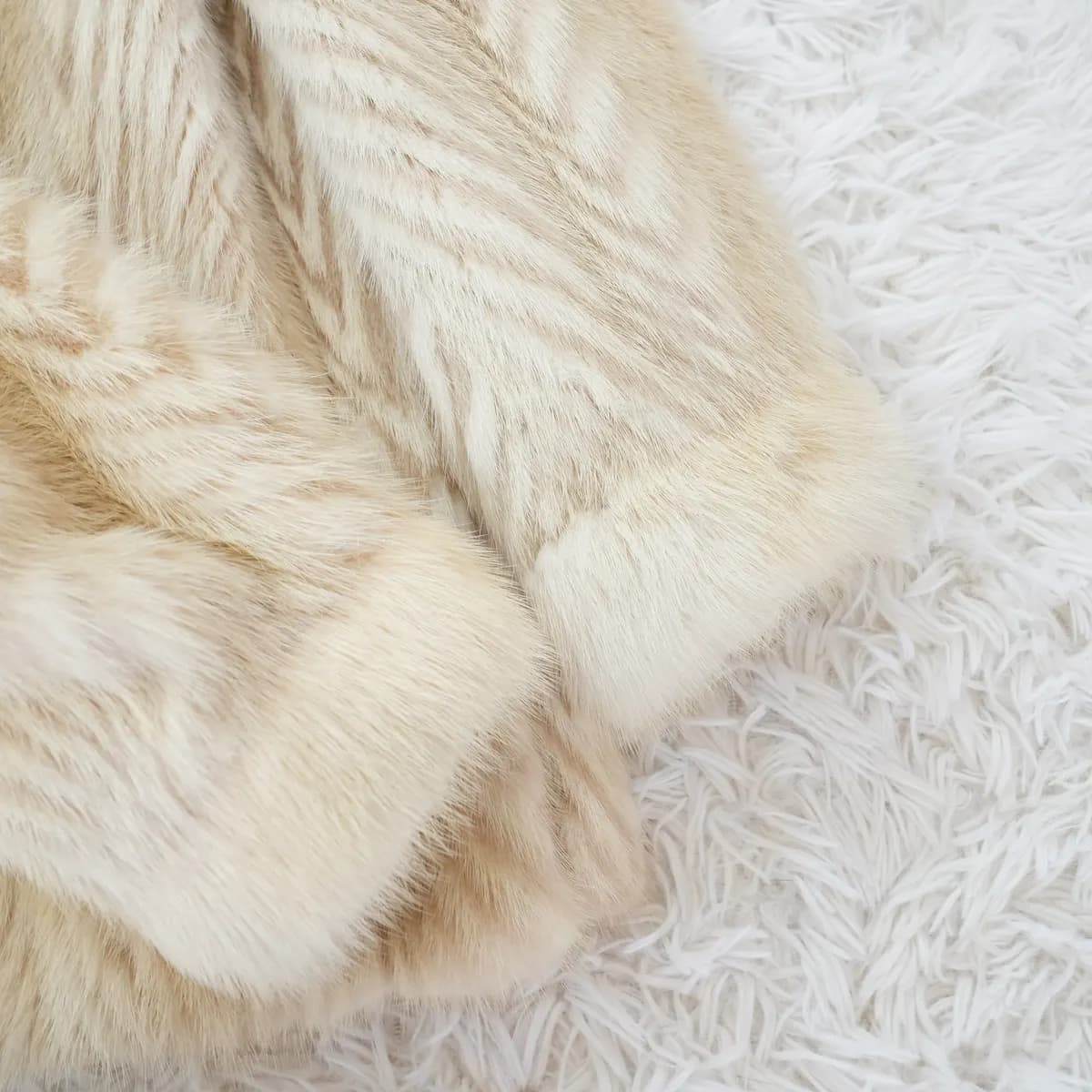
White mink is a natural white ranch colour, bred since around 1930. It is the rarest mink colour in our own stock.
Look: clear white fur; the piece pictured is worked in a zigzag pattern.
As a coat: the most striking mink colour, bright and formal. It works for evenings and with monochrome outfits.
Pros: a natural white with the short, dense feel of mink. Cons: any discolouration shows immediately on white, so inspect the collar, cuffs and shoulders closely before you buy.
Also called: Japanese: ホワイトミンク.
Dark vs mahogany vs demi-buff mink
These three browns are the classic mink coat colours, and they are easy to confuse online. Dark ranch is the deepest, mahogany is a step lighter and warmer, and demi-buff is a lighter mid-brown. The table summarises the differences.
| Dark / Blackglama | Mahogany | Demi-buff | |
|---|---|---|---|
| Colour | Deepest brown, almost black | Rich brown, lighter than dark ranch | Mid-brown, slightly darker than pastel |
| Typical label | Blackglama, American Legend | — | — |
| Fades in sunlight | Yes, toward a warmer tone | — | — |
| Feel when worn | Formal, evening | Warm, classic | Relaxed, daytime |
| How often we carry it | Occasionally | Rarely | Often |
| Japanese name | ブラックグラマ | マホガニー | デミバフ |
Ranch mink vs wild mink
Ranch mink is bred on farms; wild mink was trapped. Wild mink has a deep, rich brown coat, while ranch breeding produced larger animals and the full colour range from white to almost black. Nearly all of the colour names on this page are ranch mink.
| Ranch mink | Wild mink | |
|---|---|---|
| Colour | White to almost black, including all mutation colours | Deep, rich brown, sometimes with white spots underneath |
| Size | Larger than wild mink | Small; males around 1 kg |
| History | Bred for fur from the late 19th century | Trapped in quantity from the 19th century |
How to choose a vintage mink coat
Choose colour first, then check the leather and the wear points. Mink is durable, but a vintage coat is only as good as its leather and storage, so the checks below matter more than the label. The general step-by-step is in How to Authenticate Vintage Fur; these are the points that matter most for mink.
- Leather: the skin side should feel supple, not dry, and have no tears. Soft, well-tanned leather is generally better.
- Listen: move the coat gently near your ear. A crackling or crisp, rustling sound means the leather has dried out — avoid it.
- Underarms and neckline: these are where tears appear first. Check the seams under the arms and around the collar.
- Colour evenness: compare the shoulders and sleeves with protected areas such as under the collar. Dark mink fades toward a warmer tone in sunlight.
- Guard hair and underfur: the guard hairs should be silky and the underfur even. Thin patches at the cuffs and shoulders are a sign of wear.
- Construction: long, narrow strips visible in the fur or on the leather side usually mean the pelts were let out. That is how the coat was made, not a repair.
- Buying from photos: look closely at the shoulders and cuffs for thinning or discolouration. Sellers who show flaws in photos and comments are easier to trust; browse several pieces and conditions on the same site to see whether the shop describes condition honestly before you buy.
Some inexpensive new fur coats are made by stretching the pelts thin. They feel light and soft, but tend to lack the density and durability of a well-made older coat. A vintage coat gives an existing garment a second life — worth weighing against buying new.
For fit, see the vintage fur sizing guide. See current mink pieces → Free worldwide shipping. No customs fees at delivery.
Frequently asked questions
What colour of mink is most valuable?
There is no fixed answer, because demand for colours changes from season to season: one study of mink auction results found that the most profitable colour types were mahogany, black cross, brown cross and black in 2006/2007, but pastel and black in 2008/2009. For a vintage coat, we would choose by condition and fit first, then by the colour you will wear most.
What is Blackglama mink?
Blackglama is a trademark for the darkest, most lustrous ranch mink, created by the Great Lakes Mink Association (founded 1941) and later marketed by the American Legend Cooperative, which represented mink ranchers in the United States and Canada. It is known for the "What Becomes a Legend Most?" advertising campaign. In Japan it is written ブラックグラマ. Be aware that some ordinary dark mink coats carry a Blackglama label added afterwards, so check the balance of guard hairs and underfur rather than relying on the label alone.
What is demi-buff mink?
Demi-buff is a natural mid-brown mink, slightly darker and browner than pastel and lighter than mahogany or dark ranch. Shades vary from coat to coat. On Japanese listings it appears as デミバフ.
Is sapphire mink dyed?
No. Sapphire is a natural blue-grey colour mutation of ranch mink, developed by breeders by around 1930. It has bluish-grey underfur with mauve or blue-grey guard hairs and is also known by the trade name Cerulean. In Japanese it is サファイア.
What is the difference between ranch mink and wild mink?
Ranch mink is bred on farms and comes in colours from white to almost black; wild mink is trapped and has a deep, rich brown coat. Ranch-bred animals are larger than wild mink, whose males weigh around 1 kg. Nearly all named mink colours are ranch mink.
What does "let out" mean on a mink coat?
Letting out is a furrier's technique: the pelts are processed into narrow strips and sewn back together, which can make a mink skin almost twice as long. The technique made full-length mink garments practical, since wild mink are small animals.
Related category
Fur